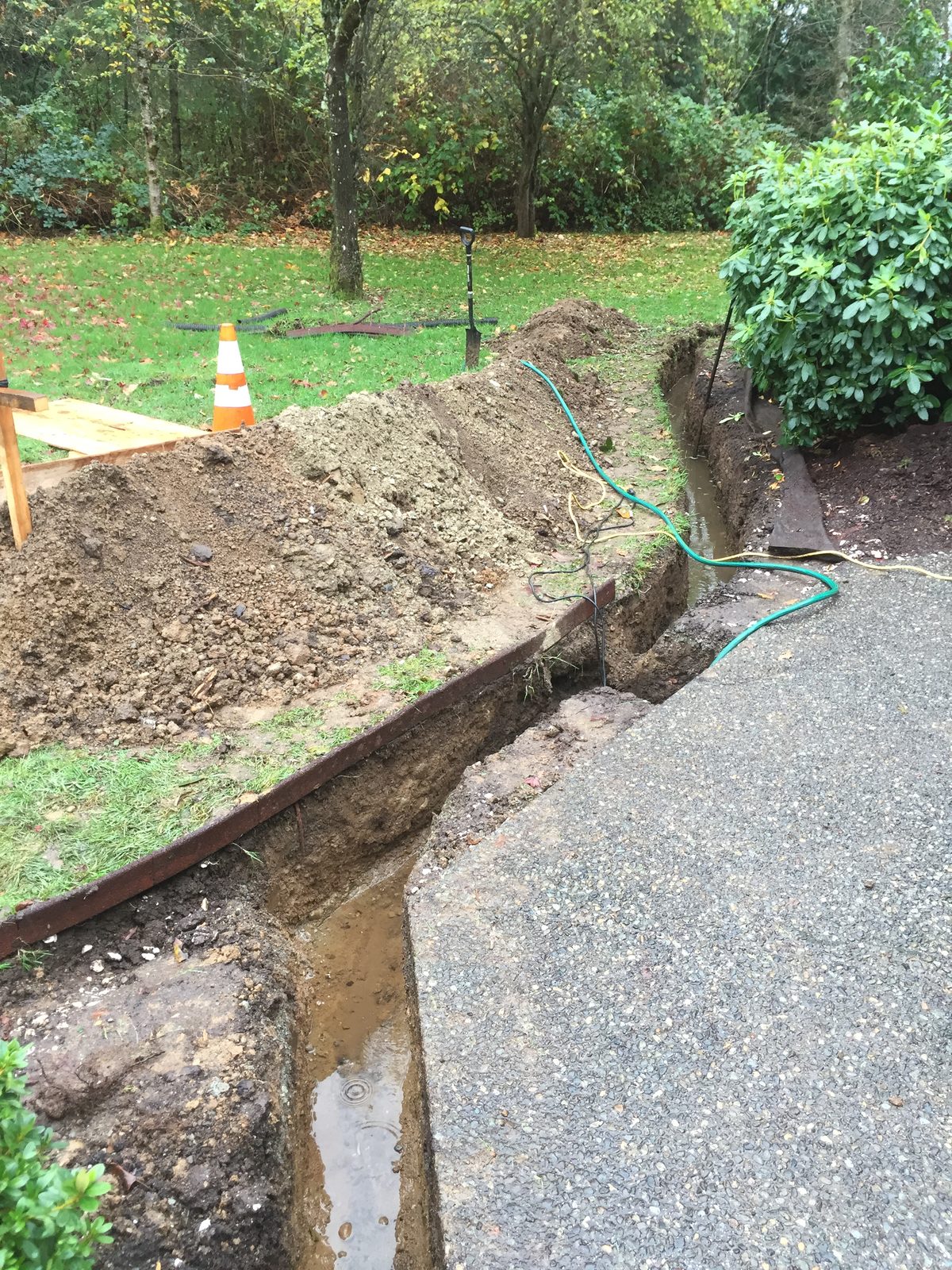
Standing water in the yard
If the rain stopped days ago and the water is still there, the problem almost certainly isn't the surface. It's about two feet down.
What's actually happening
Much of Western Washington sits on glacial till, usually 20 to 40 inches below the surface. It's dense, compacted ground that water barely passes through. Rain soaks down until it hits that layer, stops, and moves sideways along the top until it finds somewhere to collect. That's usually the low point of your yard, and sometimes it's your foundation.
So the water in your lawn may not have fallen on your lawn. It can come from a neighbour's property, a slope above you, or a driveway two hundred feet away.
This is why regrading and adding topsoil usually don't work.
Both deal with the surface, but the water is moving underneath it.
What we'd look at
Where it collects
We walk it during or just after rain, because dry ground hides the pattern.
Where it's coming from
Uphill sources, roof and driveway runoff, and what neighbouring properties are shedding.
What the soil will take
How deep the till is, and whether anything below it will actually take water.
Where it can go
A legal, practical place to send the water. This limits every other option.
The likely fix
Usually a curtain drain cut in above the wet area. It catches water as it moves across the hardpan and carries it to a discharge point. Sometimes a dry well works instead, but only where the soil below genuinely takes water. That's exactly what we can confirm instead of assuming.